
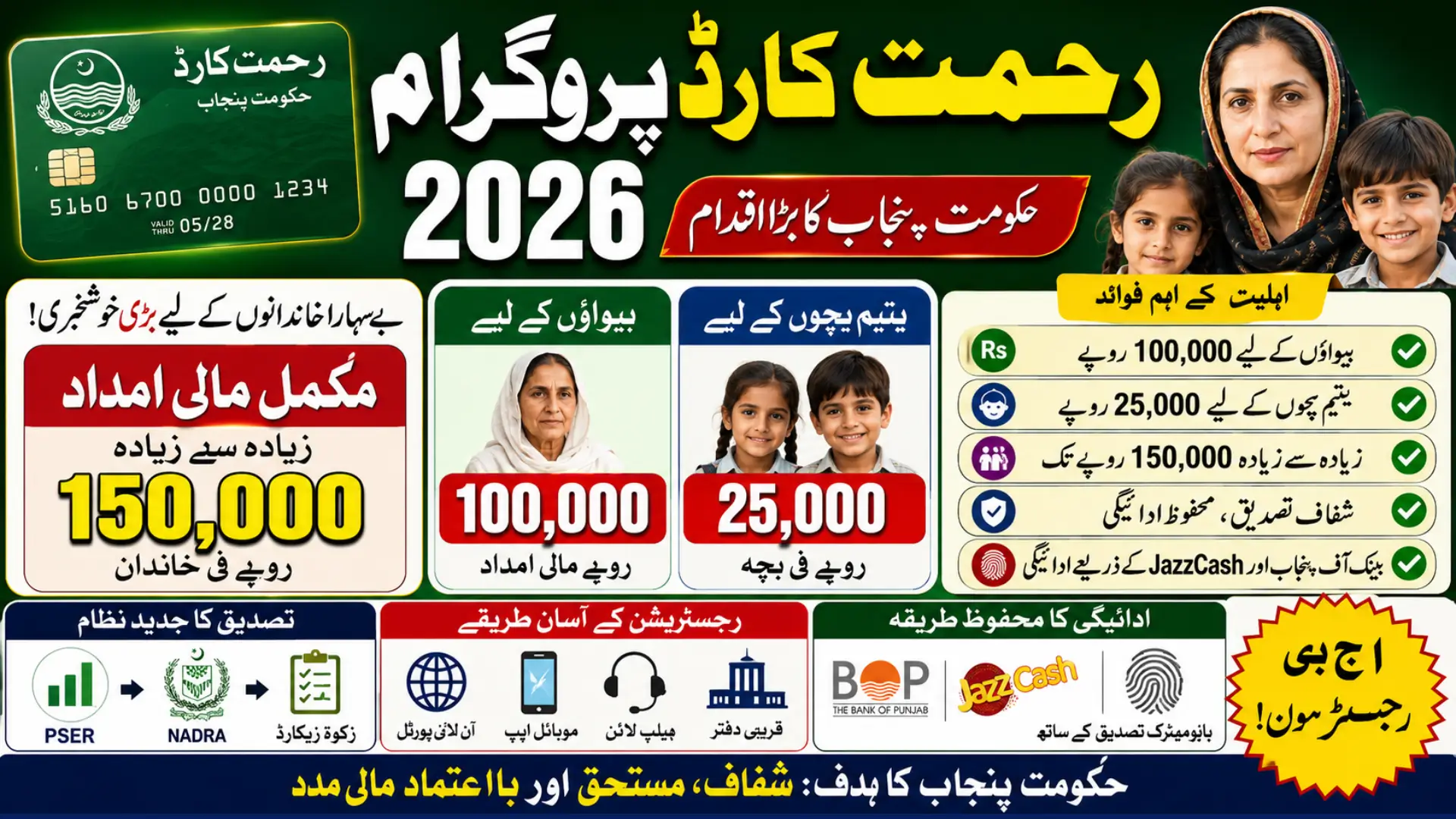
The Rahmat Card Program 2026 is one of the Punjab Government’s major social welfare initiatives designed to support widows and orphan children facing financial hardship. Instead of offering temporary assistance, the program aims to provide structured financial support through a transparent verification system that ensures eligible families receive help without unnecessary delays.
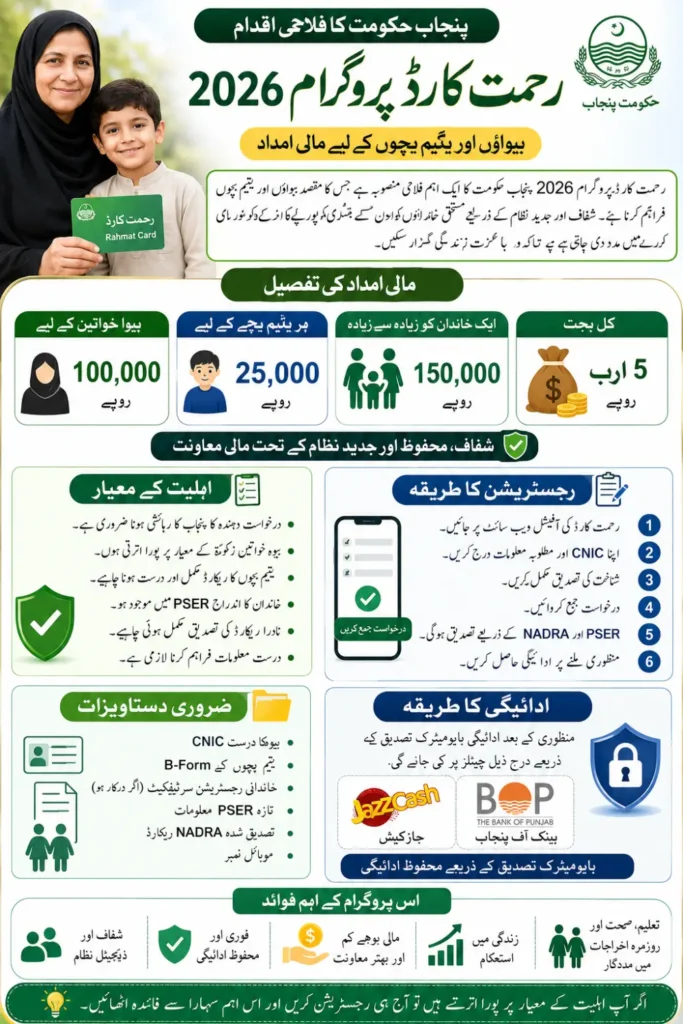
With an initial budget of Rs. 5 billion, the government plans to assist thousands of deserving households across Punjab. Through digital verification using PSER, NADRA, and biometric authentication, the program focuses on delivering financial aid safely and fairly. If you want to know how the scheme works, who qualifies, and why it is becoming important for vulnerable families, this guide explains everything in simple language.
Rahmat Card Program 2026 at a Glance
| Feature | Details |
|---|---|
| Program Name | Rahmat Card Program 2026 |
| Province | Punjab |
| Target Beneficiaries | Widows & Orphan Children |
| Total Budget | Rs. 5 Billion |
| First Phase Coverage | Around 50,000 Families |
| Widow Financial Grant | Rs. 100,000 |
| Orphan Child Assistance | Rs. 25,000 Per Child |
| Maximum Family Assistance | Rs. 150,000 |
| Verification | PSER, NADRA & Zakat Records |
| Payment Method | Bank of Punjab & JazzCash (Biometric Verification) |
What Is the Rahmat Card Program 2026?
The Rahmat Card Program is a welfare initiative introduced by the Punjab Government to provide financial assistance to deserving widows and orphan children who qualify under the Zakat eligibility criteria. The purpose is to reduce financial pressure and help families meet essential expenses such as food, healthcare, education, and daily household needs.
You can also read: Taleemi Wazaif Check Balance Online
Unlike many traditional welfare programs, this scheme emphasizes transparency. Every application goes through digital verification using official government databases, reducing the chances of fraud while ensuring that financial support reaches genuinely deserving families.
7 Most Important Benefits of the Rahmat Card Program 2026
The Rahmat Card Program offers much more than a one-time payment. It provides a structured support system that improves financial security and simplifies access to government assistance.
- Rs. 100,000 financial assistance for eligible widows.
- Rs. 25,000 support for each eligible orphan child.
- Maximum grant of Rs. 150,000 for one family.
- Transparent digital verification through PSER and NADRA.
- Secure biometric payments via Bank of Punjab and JazzCash.
- Multiple registration methods, including online and offline options.
- Reduced financial burden for families struggling with education, healthcare, and daily expenses.
These benefits are designed to provide immediate relief while strengthening long-term social protection for vulnerable households.
Who Is Eligible for the Rahmat Card Program?
Applicants must satisfy the government’s eligibility requirements before financial assistance can be approved. Verification is completed through official government records to ensure fairness during the selection process.
Generally, applicants should meet the following conditions:
- Must be a resident of Punjab.
- Widow applicants should qualify under Zakat guidelines.
- Orphan children must meet the program’s eligibility criteria.
- Family data should be available in the Punjab Socio-Economic Registry (PSER).
- NADRA records must be complete and verified.
- Applicants should provide accurate personal information during registration.
Meeting these conditions improves the chances of successful approval, although final selection depends on official verification.
How to Register for the Rahmat Card Program 2026
The Punjab Government has introduced multiple registration options to make the application process convenient for eligible families.
Follow these simple steps:
- Visit the official Rahmat Card registration portal.
- Enter your CNIC and required personal details.
- Complete identity verification.
- Submit your application.
- Wait for verification through PSER and NADRA.
- Receive approval notification if selected.
- Collect your payment through biometric verification at the Bank of Punjab or JazzCash.
Applicants who cannot apply online may also visit their nearest Zakat and Ushr Office for assistance with registration.
Documents Required for Registration
Keeping your documents ready can help avoid delays during verification.
You may need:
- Valid CNIC of the widow.
- B-Form or birth certificates of orphan children.
- Family Registration Certificate (if required).
- Updated PSER information.
- Verified NADRA records.
- Contact mobile number.
Before submitting your application, ensure that all information matches your official records.
How the Verification Process Works
The Rahmat Card Program follows a multi-step verification process to maintain transparency and prevent ineligible applications from receiving benefits. Government departments cross-check applicant information before approving financial assistance.
The verification process generally includes:
- Identity verification through NADRA.
- Household information verification through PSER.
- Zakat eligibility assessment.
- Record matching to identify duplicate or incorrect applications.
- Final approval by the concerned authorities.
Applicants should avoid providing incorrect information because mismatched records can delay or reject the application.
Payment Method Under the Rahmat Card Program
Once an application is approved, payments are released through secure digital channels. Biometric verification ensures that only the rightful beneficiary receives the financial assistance.
Payments are issued through:
- Bank of Punjab
- JazzCash
- Biometric fingerprint verification
This secure payment system minimizes fraud and improves transparency across the entire program.
You can also read: Rehmat Card Application Form
Why the Rahmat Card Program Matters
For many widows and orphan children, regular household expenses become difficult after losing the family’s primary earner. The Rahmat Card Program helps reduce these financial challenges by providing meaningful assistance that can be used for essential needs.
The program also reflects the Punjab Government’s broader effort to modernize welfare distribution. By combining digital verification, biometric payments, and official databases, the initiative promotes accountability while ensuring public funds reach deserving families.
Common Mistakes That Can Delay Approval
Many applications face delays because of incomplete or outdated records. Avoiding a few common mistakes can improve your chances of successful verification.
Keep these points in mind:
- Do not submit incorrect CNIC information.
- Ensure your PSER record is updated.
- Verify that your NADRA information is accurate.
- Use an active mobile number.
- Complete all required fields during registration.
- Do not submit multiple applications unnecessarily.
Review your application carefully before final submission to reduce the possibility of verification issues.
Helpful Tips for Applicants
Following a few practical recommendations can make the registration process much smoother.
- Update your family information in PSER before applying.
- Ensure all NADRA records are current.
- Keep original documents available during verification.
- Complete biometric verification promptly after approval.
- Stay informed through official government announcements regarding registration dates and payment updates.
Being prepared can help you avoid unnecessary delays and complete the process with confidence.
Latest Updates About Rahmat Card Program 2026
The Punjab Government has allocated Rs. 5 billion for the initial rollout of the Rahmat Card Program. During the first phase, approximately 50,000 deserving families are expected to receive financial assistance through a transparent digital system.
As the program expands, additional eligible families may be included in future phases. Applicants should continue monitoring official government announcements and ensure their PSER and NADRA records remain updated for upcoming verification rounds.
Conclusion
The Rahmat Card Program 2026 represents an important step toward strengthening Punjab’s social welfare system by providing financial assistance to widows and orphan children through a transparent and technology-driven process. With grants of up to Rs. 150,000 per family, digital verification, biometric payments, and multiple registration options, the program is designed to deliver support efficiently while minimizing fraud.
You can also read: Rehmat Card Required Documents
If you or someone in your family meets the eligibility criteria, keeping your PSER and NADRA records updated and completing the registration process correctly can improve your chances of receiving assistance. As more phases are introduced, the Rahmat Card Program has the potential to become a valuable source of financial stability for thousands of deserving families across Punjab.
Frequently Asked Questions (FAQs)
1. What is the Rahmat Card Program 2026?
It is a Punjab Government welfare scheme that provides financial assistance to eligible widows and orphan children through a transparent digital verification system.
2. How much financial assistance is available?
Eligible widows can receive Rs. 100,000, while orphan children may receive Rs. 25,000 each, with a maximum family assistance of Rs. 150,000.
3. Who can apply for the Rahmat Card Program?
Punjab residents who qualify under the Zakat criteria, have updated PSER records, and successfully complete NADRA verification may be eligible.
4. How can I register for the Rahmat Card Program?
Registration can be completed through the official online portal, mobile application, helpline, or the nearest Zakat and Ushr Office.
5. How are payments issued?
Approved beneficiaries receive payments through biometric verification using the Bank of Punjab or JazzCash.
6. What documents are generally required?
Applicants typically need a valid CNIC, updated PSER information, verified NADRA records, children’s B-Forms (if applicable), and an active mobile number.


7. What should I do if my application is delayed?
Check that your PSER and NADRA information is accurate, ensure all required documents have been submitted, and wait for the official verification process to be completed before making further inquiries.