
9999 Online Check 13000 CNIC Pakistan Ramzan Package
9999 Online Check 13000 CNIC Pakistan Ramzan Package Government of Pakistan has introduced a special Ramzan Relief Package worth Rs 13,000 to help low-income families manage their expenses during the holy month. Every year, the cost of food items and household necessities increases during Ramzan, which makes it difficult for many families to meet their daily needs. To reduce this burden, the government has started a digital system where citizens can check their eligibility using their CNIC through the 9999 service.
In recent days, thousands of people across Pakistan have been searching for 9999 Online Check 13000 CNIC Pakistan Ramzan Package to confirm whether they are eligible for this financial support. The process has been designed to be very simple so that even people living in villages or remote areas can easily check their status. A citizen only needs a valid CNIC number and a mobile phone to verify whether their family qualifies for the relief amount.
From what has been observed during the implementation of this program, the government is mainly relying on existing welfare databases such as the NSER survey. This means that families who were already part of welfare initiatives are more likely to receive the payment without going through a complicated registration process. In this article, we will explain everything step by step so that Pakistani citizens can clearly understand how to check eligibility, update their information, and collect their payment safely.
You Can Also Read: 8171 New Registration Process Via BISP Tehsil Office
Why the Government Introduced the Rs 13,000 Ramzan Relief Package
Ramzan is a special month for Muslims, but it also brings additional household expenses. Families prepare special meals for Sehri and Iftar, and daily consumption of food items increases. For families with limited income, these additional costs can create serious financial pressure.
The government launched the Rs 13,000 Ramzan assistance program to ensure that financially struggling families can observe the holy month with dignity. Instead of distributing food items only, the government decided to provide direct financial assistance so that families can buy the items they actually need.
This program is part of a larger social protection strategy aimed at supporting vulnerable citizens. Officials have emphasized that the relief package is designed specifically for households that fall below the poverty line and are already recorded in government welfare databases.
Some of the key goals behind launching this relief program include:
- Supporting low-income families during Ramzan
- Helping citizens manage rising food prices
- Providing direct cash assistance instead of complicated subsidy systems
- Using digital verification to ensure transparency
- Delivering financial aid quickly through banks and SMS verification
By focusing on these objectives, the government hopes to ensure that the financial support reaches those who truly need it.
You Can Also Read: 13000 Ramzan Package How To Check Online
How the Government Identifies Eligible Families
One of the most important questions people ask is how the government selects beneficiaries for the Rs 13,000 payment. The selection is not done randomly. Instead, it is based on detailed household data collected through national welfare surveys.
Most of the information used in this program comes from the National Socio-Economic Registry (NSER). This database contains records of millions of Pakistani households, including information about their income level, employment status, family size, and assets.
Officials analyze this data using a poverty measurement system called the PMT score. This score is calculated based on several indicators that show the economic condition of a household. Families with a lower PMT score are considered more vulnerable and are therefore prioritized for assistance programs.
From the experience of previous programs, it has been observed that families already connected with social protection schemes often receive faster approval. The system mainly considers the following factors while selecting beneficiaries:
- Household poverty score recorded in NSER
- Income level and employment conditions
- Family size and number of dependents
- Ownership of vehicles, property, or agricultural land
- Previous participation in government welfare programs
If a household’s PMT score falls below the required limit, the system may automatically mark them as eligible for the Ramzan relief payment.
You Can Also Read: Nighaban Card Distribution Launch For Payment Withdrawal
Eligibility Criteria for the 9999 Online Check 13000 Program
Before checking your status through the 9999 service, it is important to understand the eligibility conditions. The government has introduced strict rules to make sure that only deserving families receive the financial assistance.
Officials review household data carefully before approving payments. If the system detects that a family owns expensive assets or has a high income level, the application may be rejected automatically.
The most common eligibility conditions include the following points:
- Household income should usually be below Rs 50,000 to Rs 60,000 per month
- The applicant must have a valid CNIC issued by NADRA
- The family should already exist in the NSER database
- No member of the household should be a Grade 17 or higher government officer
- The household should not own luxury assets such as a registered car
- Large agricultural land ownership may reduce eligibility chances
You Can Also Read: 1000 Maryam Nawaz Registration Online 2026
Below is a simple overview of the main eligibility requirements.
| Eligibility Factor | Requirement |
|---|---|
| Monthly Household Income | Generally below Rs 50,000 – 60,000 |
| CNIC Requirement | Valid CNIC issued by NADRA |
| Welfare Database | Household data available in NSER |
| Government Employment | No Grade 17 or above government officer in family |
| Asset Ownership | No car or major land ownership |
Families who meet most of these conditions have a higher chance of receiving the Rs 13,000 Ramzan relief payment.
Step-by-Step Method to Check Eligibility Through 9999 SMS
For many Pakistani citizens, especially those living in rural areas, the SMS method is the easiest way to check eligibility. The government has introduced the 9999 SMS verification system so that people can confirm their status without visiting any office.
This system works with all types of mobile phones, including basic feature phones. It does not require an internet connection, which makes it accessible to a large number of citizens.
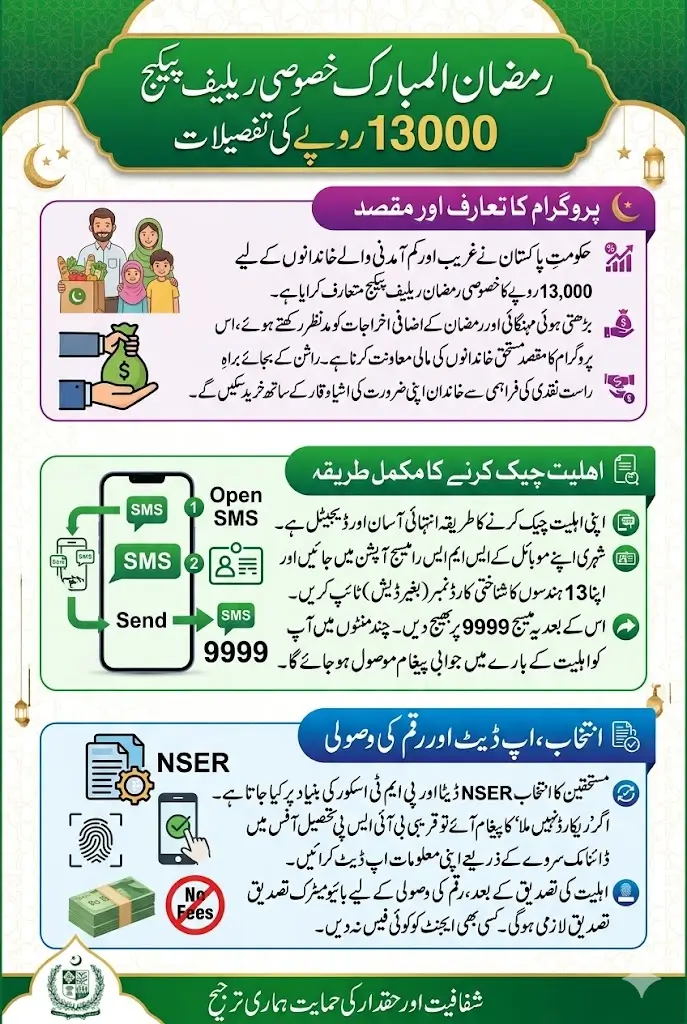
To check your eligibility through SMS, follow these steps:
- Open the SMS application on your mobile phone
- Type your 13-digit CNIC number
- Do not include dashes or spaces
- Send the message to 9999
- Wait for a response message from the system
Usually, the response arrives within a few minutes. The message will inform you whether your family is eligible for the Ramzan relief package or whether your record is missing from the database.
This simple process has helped many people quickly confirm their eligibility without traveling long distances.
You Can Also Read: KPK Ramzan Package 2026 Online Apply
How to Check the 13000 Ramzan Package Through the Online Portal
In addition to the SMS service, the government has also introduced an online portal where citizens can check their eligibility using their CNIC. This option is helpful for people who have access to the internet and want to see detailed information about their payment status.
The portal is designed to be user-friendly, and the verification process takes only a few minutes. Citizens simply need to enter their CNIC number and complete a captcha verification to view their status.
The steps for checking the payment status online are:
- Visit the official government portal
- Enter your CNIC number carefully
- Complete the captcha verification code
- Click on the Check Status option
- Wait for the system to display your eligibility result
The portal may show different results such as eligible, under verification, or record not found. These messages help applicants understand the current status of their payment.
You Can Also Read: Nighaban Dastarkhawan Free Sehri And Aftayari
What Record Not Found Means and Why It Appears
Many people become worried when they receive the message “Record Not Found” after checking their CNIC through the 9999 system. However, this message does not always mean that a person is permanently disqualified from the program.
In most cases, this message simply indicates that the household information in the government database is outdated or incomplete. If the NSER survey data is missing or very old, the system may not be able to verify the household.
Common reasons for this message include:
- The household never completed the NSER survey
- The family’s economic data is outdated
- CNIC information was entered incorrectly in the system
- The household recently changed its address or location
- The database has not yet been updated with new survey information
When this happens, the government usually advises citizens to update their household information through the official survey process.
You Can Also Read: 9999 Web Portal Check 2026 Eligibility
Updating Your Information Through the Dynamic Survey
If your CNIC shows Record Not Found, the best solution is to update your household data through the Dynamic Survey conducted at BISP Tehsil offices. This survey allows the government to collect updated information about your family’s financial condition.
During this survey, officials ask questions about household income, number of family members, employment status, and living conditions. The collected data is then uploaded into the national welfare database.
When visiting a survey center, you should bring the following documents:
- Original CNIC
- Mobile phone number registered in your name
- Basic information about family members
- Details of your income sources
After completing the survey, your data will be updated in the system. In many cases, citizens are advised to check their eligibility again after a few days or weeks.
How Beneficiaries Receive the Rs 13,000 Payment
Once the system confirms that a household qualifies for the Ramzan relief package, the payment process begins. Beneficiaries usually receive an official SMS message informing them that their payment is ready for collection.
The message may also provide instructions about where the payment can be collected. In many cases, payments are distributed through designated banks or payment centers.
The general payment process usually involves the following steps:
- Receiving an official SMS confirmation
- Visiting the designated bank or payment center
- Presenting the original CNIC for verification
- Completing biometric thumb verification
- Receiving the full Rs 13,000 cash payment
Biometric verification ensures that the payment is given only to the rightful beneficiary.
You Can Also Read: Meri Gari Scheme 2026 Online Registration
Important Safety Tips for People Receiving the Payment
During large government relief programs, some dishonest individuals try to take advantage of citizens by demanding illegal fees or commissions. It is important for beneficiaries to understand that the Ramzan relief payment is completely free.
No bank employee, agent, or middleman has the right to deduct any amount from the payment.
To protect yourself from fraud, remember the following important tips:
- Never pay any commission or service charges
- Always collect the complete Rs 13,000 amount
- Do not share your CNIC details with strangers
- Only trust SMS messages received from the official 9999 number
- Immediately report any suspicious activity or illegal deduction
By following these safety precautions, beneficiaries can ensure that they receive their full payment without any problems.


Final Thoughts
The 9999 Online Check 13000 CNIC Pakistan Ramzan Package is an important step by the government to support low-income families during Ramzan. Through digital systems like SMS verification and online portals, the authorities have tried to make the process simple, transparent, and accessible to citizens across the country.
For many households struggling with rising food prices, this financial assistance can provide meaningful support during the holy month. The key for citizens is to verify their eligibility using the official 9999 system and ensure that their household data in the NSER database is accurate.